The Sinti are a Romani subgroup that lives primarily in central Europe. When I first read the lyrics to this song and saw the “Sinti” at the end of the first line and later on in the middle of the song, in my ignorance I assumed it was a misspelling of the Spanish words “sin ti” meaning “without you.” Somewhat ironically (because of the erasure of a minority group) the song still makes sense when read that way, but it’s a lot easier to understand the whole story—including the sound—once you get the reference. If, like me, you didn’t already know, here is a video from Romani YouTuber Florian explaining who the Sinti are: https://www.youtube.com/watch?v=0XJIq_BzS9w
“Sabaku no Hana” was written by Omi, music and lyrics. While I would love to know what specifically inspired Omi to write this song, especially given the line “I am Sinti,” Omi didn’t write a blog post about it. We do get this Japanese & English bilingual post from miko, https://ameblo.jp/existtrace-miko/entry-12945203137.html, where she likens the traveling protagonists in the song’s story to exist†trace themselves. (The part about this song in the post starts from about the middle.) She also talks about how she approached her vocals, which I thought was interesting because in my opinion this is the best she’s sounded singing.
Lyrics written in Japanese characters for this song can be found here: https://linkco.re/zq78xA3C/songs/4039779/lyrics?lang=en
⭐︎
Sabaku no Hana
yogoreta machi hagareochiru kibou samayou Sinti
yamiya no ichirin no hana utsukushiku ima wo ikiru
ai wo koiutau sono koe de namae nakushita kimi to
kuchibiru hoho ni fure amaku amaku sasayaitemisete
ayashiku kuruisaita tsuki ga sotto terasu yoru ni
hibikasete motto tadoritsuku made
umareta suna no machi koko de ikiru watashi wa Sinti
kokoro no mama utau sabitsuita kako wa iranai
ai wo koiutau kono koe de kodoku matotta kimi to
kuchibiru hoho ni fure amaku amaku sasayaitemisete
ayashiku kuruisaita tsuki ga sotto terasu yoru ni
hibikasete motto tadoritsuku made
tabibito doko e mukau no
ate no nai michi wa tsuzuku
sakubougetsu no yume yo
kimi wo tsurete watashi no kakera
iketa no nara michizure nishite
itoshii mono yo
kuchibiru hoho ni fure amaku amaku sasayaitemisete
ayashiku kuruisaita tsuki ga sotto terasu yoru ni
hibikasete motto
kokou no sabaku no hana
sora yo takaku umi yo fukaku daichi ni ikiru
hanareta te wo tsunagu kimi no koe ga inochi wo moyashi
tachitomarazu ni utaitsuzuke
haruka tooku e
Desert Flower
Dirty town Hopes flaking away Wandering Sinti
A single flower on a moonless night, living beautifully in the moment
With that voice that sings for love, with you who has lost their name
Ghosting your cheek with my lips, let me hear you whisper ever so sweetly 1
On a night gently lit by a mysterious moon risen at the wrong time
Let it ring out more, til we get where we’re going
I live in this sandy town where I was born, I am Sinti
I’ll sing as my heart demands, I don’t need a rusted past
With this voice that sings for love, with you who is clad in loneliness
Ghosting your cheek with my lips, let me hear you whisper ever so sweetly
On a night gently lit by a mysterious moon risen at the wrong time
Let it ring out more, til we get where we’re going
Traveler, where are you headed?
This aimless path continues
It’s a lunar month’s dream
If only I could My fragments
Take you with me Take them with you
My beloved 2
Ghosting your cheek with my lips, let me hear you whisper ever so sweetly
On a night gently lit by a mysterious moon risen at the wrong time
Let it ring out more
Proud desert flower
Sky-high, ocean-deep, living spread across the earth
Join the separated hands Your voice sets my life afire
Keep singing without stopping
Going to far, distant lands
1. There’s no particle between the words for “lips” and “cheek(s),” so this could be “Caressing your lips and cheeks,” (assuming the missing particle is と) instead. I went with “Ghosting your cheek with my lips,” assuming the missing particle is を, because it’s a more intimate gesture and thus felt better for this song. ⤴
2. There are multiple places in this song where Jyou and miko are alternating singing the words of single lines. I didn’t point it out elsewhere because their choice of who sings what words doesn’t change the meaning of the lines in those sections. The bridge, however, is different. I’ve used regular print to show what miko is singing, italics for what Jyou sings, and bold for when they sing the same thing together.
Note that the fourth and fifth lines of the bridge are actually two sentences split in half. If you’re only reading the lyrics, you might interpret these lines as:
I’ll take you with me, my fragments
If I could go I’d take you with me
But listening to the song and noting that Jyou and miko are alternating midway through these lines, we get the much more logical, but split, “If only I could take you with me” and “Take my fragments with you.” ⤴
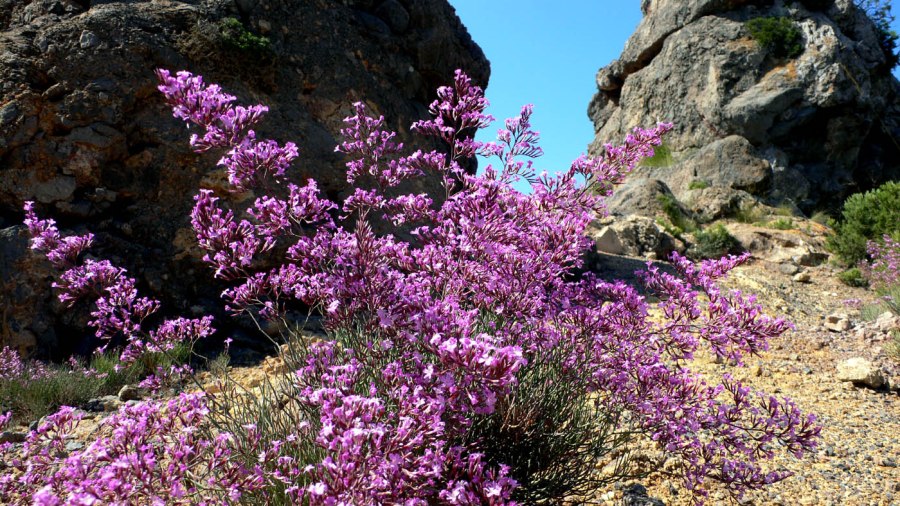
The image in the header is of the flower sea lavender (limonius insignis) found in the Tabernas desert of Spain. I don’t know what desert flower Omi was thinking of. Photo is in the public domain from: https://commons.wikimedia.org/wiki/File:Limonium_insigne1.jpg
 Warped Frost

Thanks for the translation! I loved this song from the moment I heard it at one of their (live streamed) lives nearly 5 years ago, I was so happy they decided to release it!
I tried searching Omi’s blog to see if she had anything to say about the song back when they first performed it (back in 2013 apparently!) but although she had a blog post about that particular live, she didn’t discuss this song at all. Something I did find interesting was that another song that debuted that night, the yet-unreleased Kono Sora no Shita de, apparently had some vocals performed by Omi herself. Interesting to see she was experimenting with vocals even before she wrote Tozasareta Sekai.
Oh wow, I had no idea the song was that old! Thanks for sharing that. I should know better by now but I definitely fell into a subconscious assumption that new album = new material and didn’t even think to search Omi’s older blog posts.
This was definitely a standout track for me on my first listen of Who I Am. This one and Venus.
Thanks for commenting!